If you use HubSpot for email marketing, lead management, or customer tracking, one of the first things you will want is automatic contact syncing from WordPress.
Without automation, your CRM quickly becomes outdated.
New users register on your website, but never appear in HubSpot.
Customers purchase products, but sales pipelines are never updated.
Memberships expire, but contacts remain tagged as active leads.
Most WordPress site owners try to manage this manually at first. They export CSV files, import contacts into HubSpot, and constantly clean up lists by hand.
That works for small sites, but it becomes difficult once your user base starts growing.
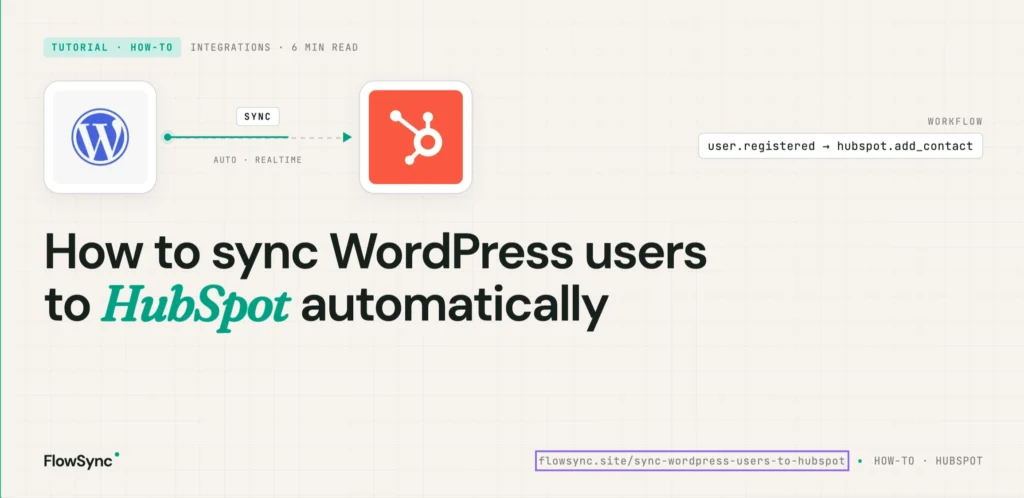
In this guide, I will show you how to automatically sync WordPress users to HubSpot using FlowSync.
You will learn how to:
- Connect WordPress to HubSpot
- Automatically send users into HubSpot workflows
- Segment contacts based on WordPress activity
- Automate membership and WooCommerce syncing
- Keep your CRM updated automatically
FlowSync focuses specifically on WordPress CRM and email automation workflows. Instead of relying on manual exports, it listens for events happening on your site and syncs contacts automatically.
Why Manual HubSpot Syncing Becomes a Problem
Here is a common example.
You run a WooCommerce store.
Every new customer should:
- Be added to HubSpot
- Enter a post-purchase email sequence
- Be tagged based on purchased products
- Be assigned to the correct audience segment
If this process is manual, things eventually break.
Some contacts never get added.
Some users end up duplicated.
Some customers receive the wrong emails because segmentation was not updated properly.
The bigger the site gets, the harder it becomes to manage manually.
Automation solves this problem by syncing WordPress activity directly into HubSpot.
What FlowSync Automates
FlowSync is built around trigger-based CRM workflows inside WordPress.
Typical HubSpot automations include:
- Add new WordPress users to HubSpot
- Sync WooCommerce customers
- Send membership users into HubSpot lists
- Trigger onboarding campaigns
- Segment users based on purchases
- Sync leads from forms
- Remove inactive or expired users automatically
The workflow structure is simple:
- Trigger
- Condition
- Action
For example:
- Trigger: WooCommerce order completed
- Condition: Product category equals Courses
- Action: Add contact to HubSpot list
This makes workflows easier to manage later, especially on larger websites.
Step 1: Install FlowSync
Install and activate FlowSync on your WordPress website.
After activation, open the FlowSync dashboard in your WordPress admin panel.
You should see sections such as:
- Workflows
- Integrations
- Logs
- Settings
Step 2: Connect HubSpot to WordPress
Next, connect your HubSpot account.
Go to:
FlowSync → Integrations
Find HubSpot and click Configure.
Depending on the integration setup, you may either:
- Connect using OAuth
- Authorize your HubSpot account directly
Once connected, FlowSync will be able to create and update HubSpot contacts automatically.
Step 3: Create Your First Workflow
Now let’s create a basic automation.
We will build this workflow:
When a user registers on WordPress, automatically create a contact in HubSpot.
Go to:
FlowSync → Workflows → Add New
Choose a Trigger
Select:
- WordPress User Registered
This tells FlowSync to run the workflow whenever a new user account is created.
Add Conditions (Optional)
Conditions allow you to filter which users should be synced.
For example:
- Only sync Customers
- Only sync Members
- Only sync WooCommerce buyers
- Only sync users from a specific membership plan
If you want every user synced to HubSpot, you can skip conditions.
Add the HubSpot Action
Next, add an action.
Choose:
- Sync Contact to HubSpot
You can map fields such as:
- Email address
- First name
- Last name
Save the workflow and activate it.
New users will now be synced automatically to HubSpot.
Membership Site Example
Let’s look at a more practical setup.
Suppose you run a membership website using ProfilePress.
You want:
- Active members added to HubSpot
- Expired members removed from campaigns
- Trial users placed into a separate onboarding sequence
You can create workflows for each scenario.
Workflow 1: Active Members
- Trigger: Subscription Activated
- Condition: Membership Plan = Premium
- Action: Add contact to HubSpot
Workflow 2: Expired Members
- Trigger: Subscription Expired
- Action: Remove contact from active campaign list
This keeps your CRM cleaner automatically.
Your email campaigns become more accurate because HubSpot always reflects the user’s current membership status.
WooCommerce Example
WooCommerce automation is another common use case.
Example workflow:
- Trigger: Order Completed
- Condition: Product Category = Electronics
- Action: Sync customer to HubSpot
This helps with:
- Product segmentation
- Customer follow-up emails
- Upsell campaigns
- Customer lifecycle tracking
Instead of treating every buyer the same way, you can segment customers based on actual purchase behavior.
Form Lead Automation
You can also send WordPress form submissions directly into HubSpot.
For example:
- Trigger: WPForms form submitted
- Action: Create HubSpot contact
This works well for:
- Consultation forms
- Lead capture forms
- Newsletter forms
- Demo requests
Instead of manually copying leads into HubSpot, the process happens automatically in the background.
Common Mistakes to Avoid
Syncing All Contacts Into One Audience
A lot of people create one giant list for every contact.
That becomes difficult to manage later.
Instead, separate contacts based on:
- Membership status
- Product purchases
- User roles
- Form submissions
- Customer lifecycle stage
Better segmentation usually leads to better conversion rates.
Forgetting Cleanup Workflows
Adding contacts is only part of the process.
You should also automate:
- Removing expired members
- Removing cancelled subscribers
- Moving inactive users into re-engagement campaigns
This keeps your HubSpot data cleaner over time.
Not Testing the Workflow
Always test your automation before using it on a live audience.
Create a test account and confirm:
- The contact appears in HubSpot
- Fields sync correctly
- The correct audience or workflow is used
- Duplicate contacts are not created
Why Native WordPress CRM Automation Matters
Some site owners use external automation platforms to connect WordPress and HubSpot.
That setup can work, but it also introduces another layer that can fail.
With a native WordPress automation workflow:
- The workflow runs closer to your actual data
- Membership plugins integrate directly
- User events trigger instantly
- CRM syncing stays inside WordPress
- There are fewer moving parts to troubleshoot
FlowSync focuses specifically on WordPress CRM workflows instead of trying to become a general automation platform.
FAQ
Can I sync existing WordPress users to HubSpot?
Yes. You can manually run workflows to sync existing users into HubSpot.
This is useful when connecting a live website to HubSpot for the first time.
Does this work with WooCommerce?
Yes. WooCommerce triggers can automatically sync customers into HubSpot based on orders, products, or categories.
Can I remove users from HubSpot automatically?
Yes. You can create workflows that remove users from specific audiences when memberships expire or subscriptions are cancelled.
Does this require coding?
No. The workflows are created directly inside WordPress using the FlowSync interface.
Can I sync form leads into HubSpot?
Yes. Form submissions from supported form plugins can automatically create or update HubSpot contacts.
Final Thoughts
Manually managing CRM contacts becomes difficult once your WordPress site starts growing.
Users register, memberships change, products are purchased, and customer data constantly changes.
Without automation, your CRM quickly becomes outdated.
A proper WordPress-to-HubSpot workflow helps you:
- Reduce manual work
- Improve segmentation
- Keep customer data updated
- Trigger onboarding sequences faster
- Build cleaner marketing automation systems
The goal is simple.
When something important happens on your WordPress site, your CRM should react automatically.
That is exactly what FlowSync is designed to do.

FlowSync
FlowSync syncs members, customers, and form leads to Brevo, Mailchimp, HubSpot, Klaviyo, and more based on activity happening on your WordPress site.