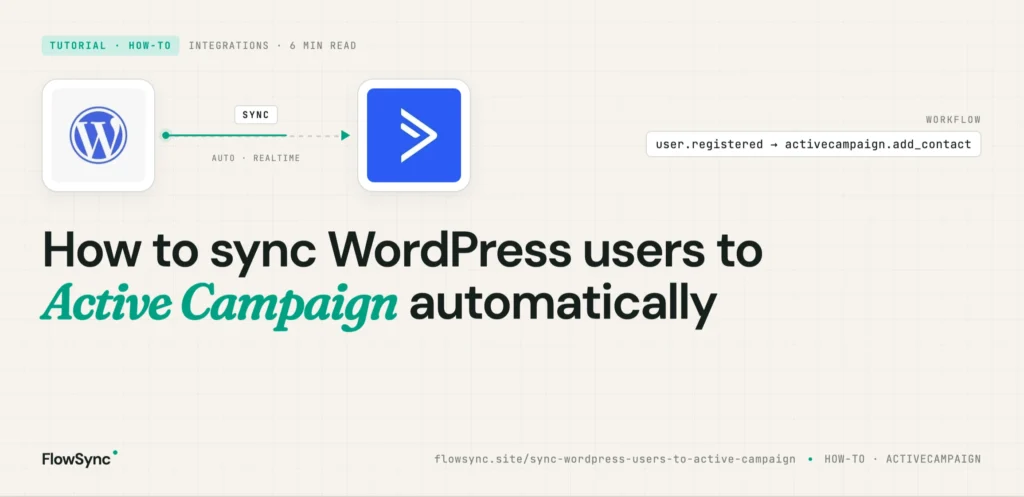
If you use ActiveCampaign for email marketing and customer automation, one of the hardest parts is keeping your WordPress users synced properly.
New users register on your website, but they never appear inside ActiveCampaign. Customers purchase products, but your automation sequences never start. Members cancel subscriptions, but they still remain inside active marketing campaigns.
None of this is something breaking. WordPress and ActiveCampaign are two separate systems that don’t share a contact record by default, so until you connect them, everything that happens on your site stays on your site.
Many WordPress site owners handle this manually at first. They export contacts from WordPress, upload CSV files to ActiveCampaign, and manage segmentation manually. That works for small sites. Once the website starts growing, it quickly becomes difficult to manage.
This guide walks through replacing that with FlowSync, so a new registration pushes the contact into ActiveCampaign the moment it happens, with no export step and no middleware between your site and your CRM. You’ll build the core sync first, then add tagging based on what users actually do on your site, which is where ActiveCampaign gets genuinely useful.
The CSV export is slower and riskier than it looks
The manual version works exactly once. You export your users, upload the file, and the two systems agree for about an hour, until the next person registers and the file is already stale. So you either run the export again or let the gap grow until you remember.
The slowness is the obvious cost. The quieter one is that every export puts a file full of names and email addresses on someone’s laptop, in an email thread, or in a shared drive. That is personal data, and under the GDPR and the CCPA, you are responsible for where it is stored and who can access it. A recurring spreadsheet of contacts is exactly the kind of loose copy that turns a small mistake into a reportable one. Syncing directly from your site to ActiveCampaign via the API removes that copy entirely, so this is as much a data-handling improvement as a time-saver.
Connect ActiveCampaign to FlowSync
You need two values from your ActiveCampaign account: the API URL and the API key. Both live in the same place.
- Sign in to ActiveCampaign, open Settings, and go to Developer. Copy the API URL (it looks like
https://youraccount.api-us1.com) and the API key shown below it. - In your WordPress admin, go to FlowSync → Integrations → ActiveCampaign → Connect.
- Paste both values and click test. FlowSync verifies the credentials and pulls in your ActiveCampaign lists and tags so they’re available for selection in the builder.
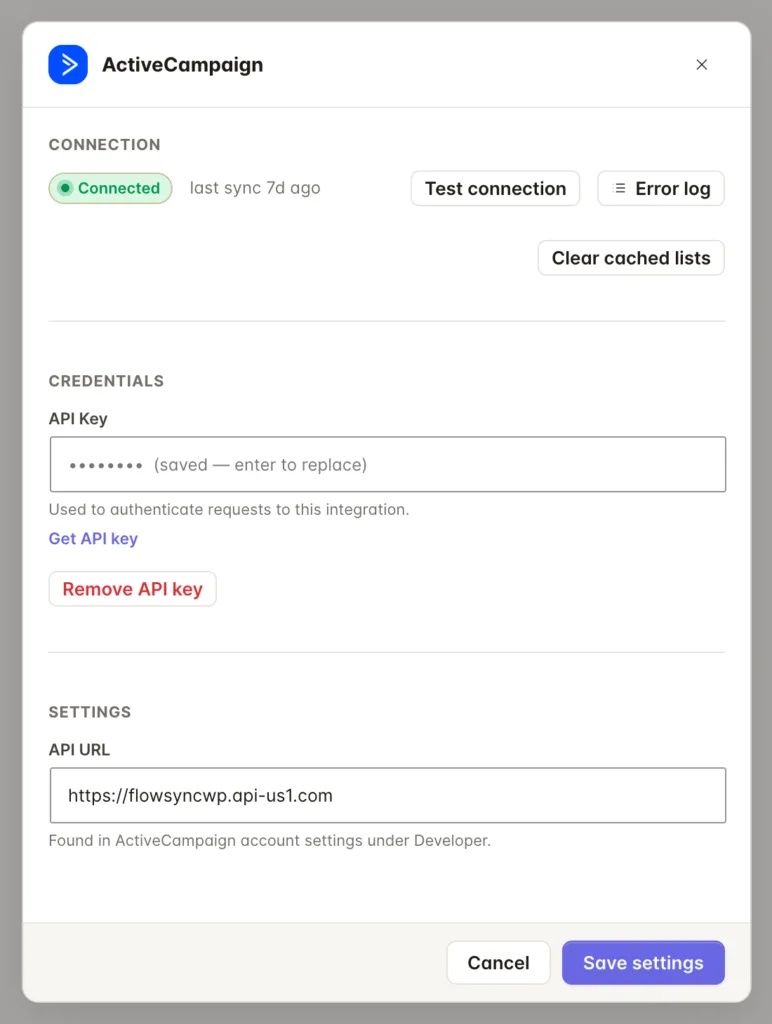
For developers: FlowSync talks to the ActiveCampaign API v3 with per-account key auth, no OAuth step. Contact pushes go through the
contact/syncendpoint, which upserts by email, so a workflow that fires twice for the same user updates the existing contact rather than creating a duplicate. The connection check is cached for five minutes, so a revoked key shows up in the integration status within that window rather than instantly.
Build the registration sync
The first workflow is the one the title promises: when a user registers on WordPress, add them to an ActiveCampaign list.
- Create a new workflow and click the trigger node.
- Choose WordPress as the source and User Registered as the trigger.
- Click + Add step → ActiveCampaign and pick Add to ActiveCampaign List (
activecampaign_add_to_list). - Select the list new users should land in.
- Map the fields. On the free plan you can map the user’s email, first name, and last name, which is everything ActiveCampaign needs to create or match a contact.
- Click the Create workflow button to save your changes.
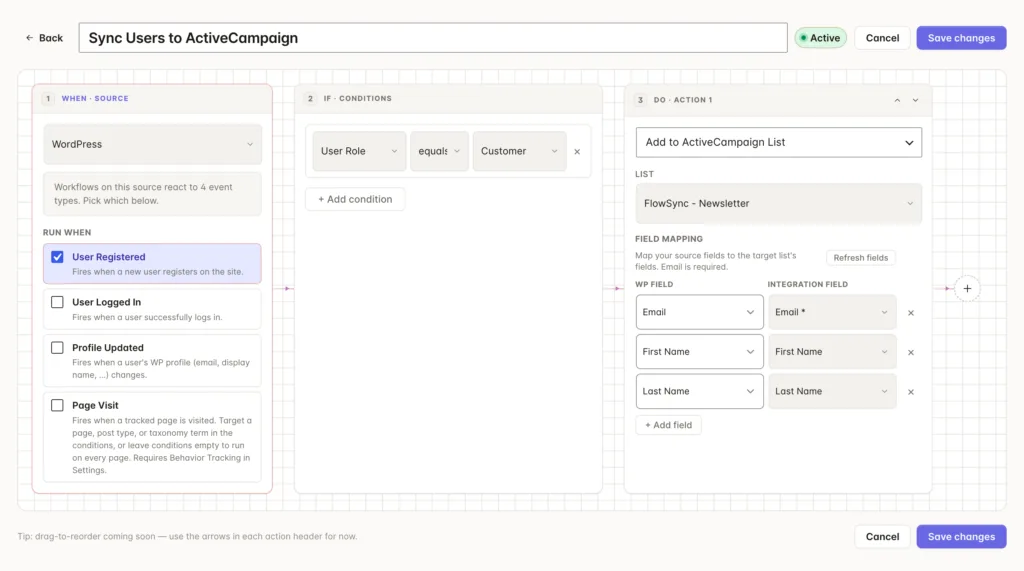
That’s a complete, working sync. Every new registration now lands in that list automatically, and your welcome automation in ActiveCampaign can trigger off list membership the same way it would for any other contact.
If you don’t want every registration synced, add a condition before the action. Conditions filter who the workflow runs for, so you can require a specific user role, a membership plan, or a custom field value, and only matching users cross over. Conditions are included on the free plan; they combine with AND and OR, so one workflow can require several things at once.
For developers: The free plan maps
user_email,first_name, andlast_nameto ActiveCampaign’sfirstName, andlastName. Pro unlocks mapping beyond that, including phone and ActiveCampaign custom contact fields, which FlowSync pulls from the account so they’re pickable rather than typed by ID. Custom field values are applied after the contact record syncs, then the list subscription is added, in that order.
Tag contacts by what they do on your site
Lists get a contact into ActiveCampaign. Tags are how you record what they’ve done, and they’re the part of ActiveCampaign most automations actually key off. FlowSync ships dedicated tag actions for ActiveCampaign: Add ActiveCampaign Tag (activecampaign_add_tag) and Remove ActiveCampaign Tag (activecampaign_remove_tag).
Tags in ActiveCampaign are global rather than tied to a list, so a tag action doesn’t ask you to pick a list at all. You name the tag, and FlowSync applies it to the contact. If the tag doesn’t exist in your account yet, FlowSync creates it, and if the contact doesn’t exist yet, the add-tag action creates the contact first and then tags them, so you can use a tag action as the only step in a workflow without pairing it with an add-to-list step.
A few workflows this enables:
- User Registered → Add tag
wp-user, so you can always segment site accounts apart from contacts who only ever filled in a form. - Order Completed → Add tag
customer, with a condition on the product or category if you want purchase-specific tags. (WooCommerce is one of FlowSync’s sources, so order events are available as triggers the same way registration is.) - Subscription Expired → Remove tag
active-member, which flips the contact out of any ActiveCampaign automation that requires the tag.
For developers: The add-tag action is create-then-tag. It upserts the contact through
contact/syncwith email plus whatever name fields resolve, then resolves or creates each tag and applies it. The remove-tag action is the opposite shape: it never creates anything. A contact that isn’t in ActiveCampaign, or a tag the contact doesn’t carry, is treated as a no-op success rather than an error, so cleanup workflows don’t fail on users who were never synced in the first place.
Keep membership status in sync
If you run a membership site, registration is only the first event that matters. ProfilePress is one of FlowSync’s membership sources, so subscription lifecycle events are available as triggers, and the pattern that keeps your ActiveCampaign audience honest is a pair of workflows rather than one.
Workflow 1: new members. Trigger on Subscription Created, add a condition for the plan if you run more than one, and add the contact to your members list or apply a plan-specific tag. This is what starts your member onboarding automation in ActiveCampaign.
Workflow 2: expired members. Trigger on Subscription Expired and use Remove from ActiveCampaign List (activecampaign_remove_from_list) or the remove-tag action against the same list or tag. The removal is non-destructive: the contact and their history stay in ActiveCampaign, they just stop matching your active-member segments.
The second workflow matters more than it looks. Someone whose membership lapsed last month and who is still receiving member-only campaigns is a prime candidate to hit the spam button, and the complaint rate is the number that quietly drags down deliverability for your whole account.
Sync form leads too
Registrations and orders cover users with accounts, but most sites also collect leads through forms. FlowSync’s Form Submitted trigger covers the major form plugins, including WPForms, Gravity Forms, Fluent Forms, Contact Form 7, Elementor Forms, and SureForms, so a newsletter signup or a lead magnet form can feed ActiveCampaign through the same workflow builder: form submitted, optional condition, add to list or tag.
This replaces the other common manual habit, exporting form entries and importing them as contacts later, with the same direct-to-API sync that the rest of your workflows use.
Common mistakes
- Putting everyone in one list with no tags. It’s the fastest setup and the one that makes ActiveCampaign least useful. Even if you start with a single list, add the tag actions from day one so contacts carry a record of how they arrived.
- Skipping the expiry workflow. Add-to-list on its own only ever grows your audience. Pair every add with the matching remove, or your segments drift away from reality within a few months.
- Typing tag names inconsistently. ActiveCampaign treats
Customerandcustomeras different tags, and FlowSync will create whichever one you typed. Pick a convention and stick to it. - Not running a test. Register a test account before you trust the workflow with live traffic. The run log shows exactly what FlowSync sent to ActiveCampaign and what came back, so a wrong list or a failed field map is visible immediately.
FAQ
Can I sync users who registered before I installed FlowSync? New registrations sync automatically. To backfill existing users, use a manual bulk run, which is a Pro feature that processes your current user base through the workflow in batches.
Will this create duplicate contacts? No. Contact pushes are matched by email through ActiveCampaign’s sync endpoint, so re-running a workflow for the same user updates the existing contact.
Does this work with WooCommerce and membership plugins? Yes. WooCommerce orders, ProfilePress subscriptions, and other membership lifecycle events are available as triggers, so the same patterns in this guide apply to customers and members, not just registrations.
What’s free and what’s Pro? Free covers the core sync: the User Registered trigger, conditions, the add and remove list actions, the tag actions, and field mapping for email, first name, and last name, across up to three workflows. Pro adds field mapping beyond email and name, including ActiveCampaign custom fields, plus manual bulk runs for syncing existing users.
Set it up
Install FlowSync, connect ActiveCampaign with your API URL and key, and build the registration workflow. The free plan includes three workflows, which is enough for the registration sync, a tag workflow, and an expiry cleanup alongside it.
Install FlowSync free, 3 workflows included
For every ActiveCampaign action FlowSync supports, see the ActiveCampaign integration page, and for the full list of plugins that can act as triggers, see the sources page.

FlowSync
FlowSync syncs members, customers, and form leads to Brevo, Mailchimp, HubSpot, Klaviyo, and more based on activity happening on your WordPress site.